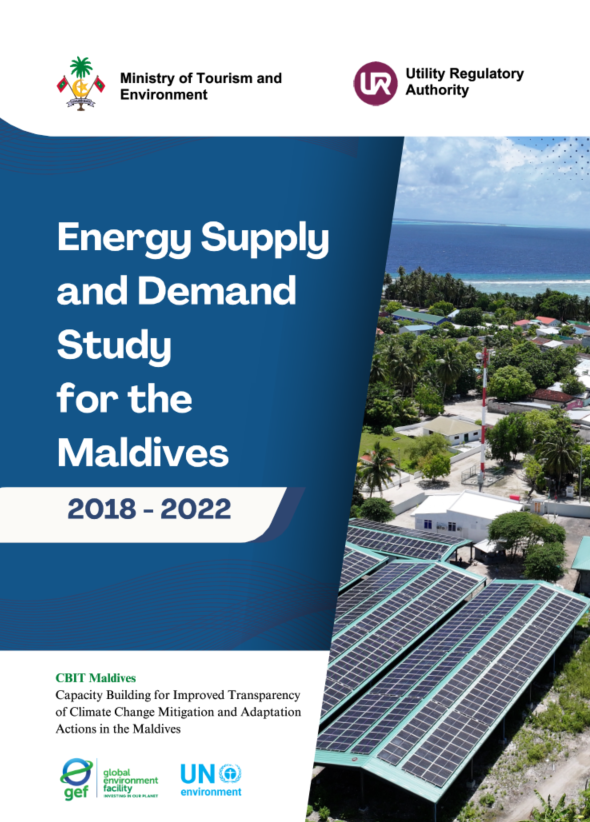
The Utility Regulatory Authority (URA) has published the Energy Supply and Demand Study for the Maldives (2018–2022), a comprehensive report that sheds light on how energy is produced, supplied, and consumed across the country. The study was developed with support from the Ministry under the Capacity Strengthening for Improved Transparency of Climate Change Mitigation and Adaptation Actions in the Maldives (CBIT Maldives) Project, funded by the Global Environment Facility (GEF) and supported by the United Nations Environment Programme (UNEP).
The report covers a five-year period from 2018 to 2022 and highlights the impacts of the COVID-19 pandemic on the Maldives’ energy supply and demand.
🔹 Primary Energy Supply
The primary energy supply rose from 28,053 TJ in 2018 to 35,107 TJ in 2022, with petroleum remaining the main source. In 2020, supply declined to 25,695 TJ due to the impacts of the COVID-19 pandemic, before recovering in 2021 and surpassing pre-pandemic levels by 2022. Renewable energy supply has shown steady growth, expanding from 14 TJ in 2018 to 275 TJ in 2022.
🔹 Electricity Generation
Electricity generation increased from 1,242 GWh in 2018 to 1,887 GWh in 2022, reflecting growth in population, tourism, and urban development. Solar PV generation reached 71.4 GWh, accounting for 3.7% of total electricity supply in 2022, highlighting the impact of targeted investments in renewable energy.
🔹 Demand for Energy
Total energy demand grew from 18,931 TJ in 2018 to 22,470 TJ in 2022. Transport accounted for the largest share, though demand fell sharply to 10,678 TJ in 2020 due to the COVID-19 pandemic before recovering in subsequent years.