This page provides access to essential resources to support both state and non-state actors in identifying, planning, and reporting climate-related activities. These tools are aligned with the Maldives’ Nationally Determined Contributions (NDCs) and support the Enhanced Transparency Framework (ETF) under the Paris Agreement.
The resources were developed under the project “ Capacity Building for Improved Transparency of Climate Change Mitigation and Adaptation Actions in the Maldives (CBIT Maldives) ”, funded by the Global Environment Facility (GEF) and implemented with support from UN Environment Programme (UNEP).
Climate Finance Classification
This indicative list of activities has been developed based on international best practices and is aligned with the Maldives’ Nationally Determined Contributions (NDCs), ensuring it reflects the national context and priorities. It serves as a reference tool to help stakeholders identify activities that can be considered climate-relevant for the purposes of planning, implementation, and reporting. The list is neither prescriptive nor exhaustive and should be viewed as a living document. Periodic review and updates are encouraged to ensure its continued relevance, including the addition or removal of activities as appropriate.
Each listed activity is tagged with a thematic category:
- M = Mitigation (reducing greenhouse gas emissions)
- A = Adaptation (building resilience to climate impacts)
- C-C = Cross-cutting (contributing to both mitigation and adaptation)
- L&D = Loss and Damage (addressing unavoidable climate impacts)
Sectors Included
Scaling up Renewable Energy 🟦 Enhancing Energy Efficiency 🟦 Waste Management 🟦 Transitioning to Efficient Transport 🟦 Agriculture and Food Security 🟦 Enhancing Water Security 🟦 Infrastructure Resilience 🟦 Public Health 🟦 Coastal Protection 🟦 Safeguarding Coral Reefs and Biodiversity 🟦 Tourism 🟦 Fisheries 🟦 Early Warning and Systematic Observation 🟦 Disaster Risk Reduction and Management 🟦 Technology 🟦 Gender, Children and Youth 🟦 Climate Advocacy, Education and Empowerment 🟦 Finance 🟦 Loss and Damage 🟦 Policy and Governance
Note: If you are unable to find an activity that is related to the activity you are reporting, please note as “other” and provide as much information on your type of activity and how it is relevant to climate action.
Resources for State Actors
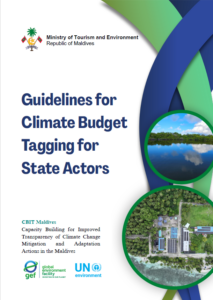
Guidelines for Climate Budget Tagging for State Actors
The Guidelines provides a structured approach for identifying and tracking climate-related activities, programs, and projects within the Maldives’ national budget. The focus is on establishing and operationalizing an effective budget tagging system that enables consistent, transparent reporting on climate finance.
This guidelines are primarily intended for state actors whose budgets are processed through the Ministry of Finance. By ensuring a standardized approach across government sectors, they help the Maldives strengthen its ability to meet reporting obligations under the United Nations Framework Convention on Climate Change (UNFCCC) and to regularly collect, collate, verify, and report climate finance data.
Drawing on the best international practices from other Small Island Developing States (SIDS) and developing countries, the guidelines are designed to complement existing national tools and mechanisms. They ensure that expenditures are tracked in line with internationally recognized definitions of climate finance while remaining coherent with the Maldives’ Nationally Determined Contributions (NDCs).
Key elements of the guidelines include:
- A detailed methodology for defining climate finance, financing instruments, and eligible sources.
- Identification of government sectors and institutions included in the tagging process.
- Methods for estimating climate relevance of budget items.
- Institutional roles, responsibilities, and governance arrangements for managing the process.
- Measures for verification and quality assurance.
- Practical guidance on integrating tagging into the budget cycle.
Resources for Non-State Actors
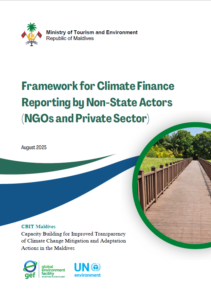
Framework for Climate Finance Reporting by Non-State Actors (NGOs and Private Sector)
The Framework establishes a national mechanism for NGOs and private sector actors to systematically and transparently report the climate finance they receive and invest in climate-related actions.
Currently, most available climate finance data in the Maldives is sourced from government ministries and public projects. Reporting by non-state actors (NSAs) remains very limited due to the absence of formal systems or guidance. This Framework addresses that gap by providing clear direction for NSAs to report their contributions—helping to strengthen the Maldives’ ability to meet its reporting obligations under the United Nations Framework Convention on Climate Change (UNFCCC).
This Framework includes:
- Definitions of key terms, and types of finance and climate actions relevant to the Maldivian context.
- Institutional arrangements for coordinating NSA reporting.
- Clear reporting protocols, including information requirements and reporting frequency.
- Standardized templates and data collection forms.
- A review process to keep the Framework up to date.
- Guidance on the climate finance classification system developed under this project.
A supporting legal guideline will be developed to formalize and sustain the Framework. Together, these elements lay the foundation for stronger, more inclusive climate finance reporting in the Maldives, ensuring that contributions from all actors are captured, recognized, and aligned with UNFCCC requirements. As a living document, the Framework will be periodically reviewed and updated in line with evolving national and international contexts.